Is IPTV legal? What the law actually says
IPTV is just a delivery method. Whether your subscription is legal depends entirely on whether the service holds a broadcasting licence. Here is how to tell the difference and check for yourself.
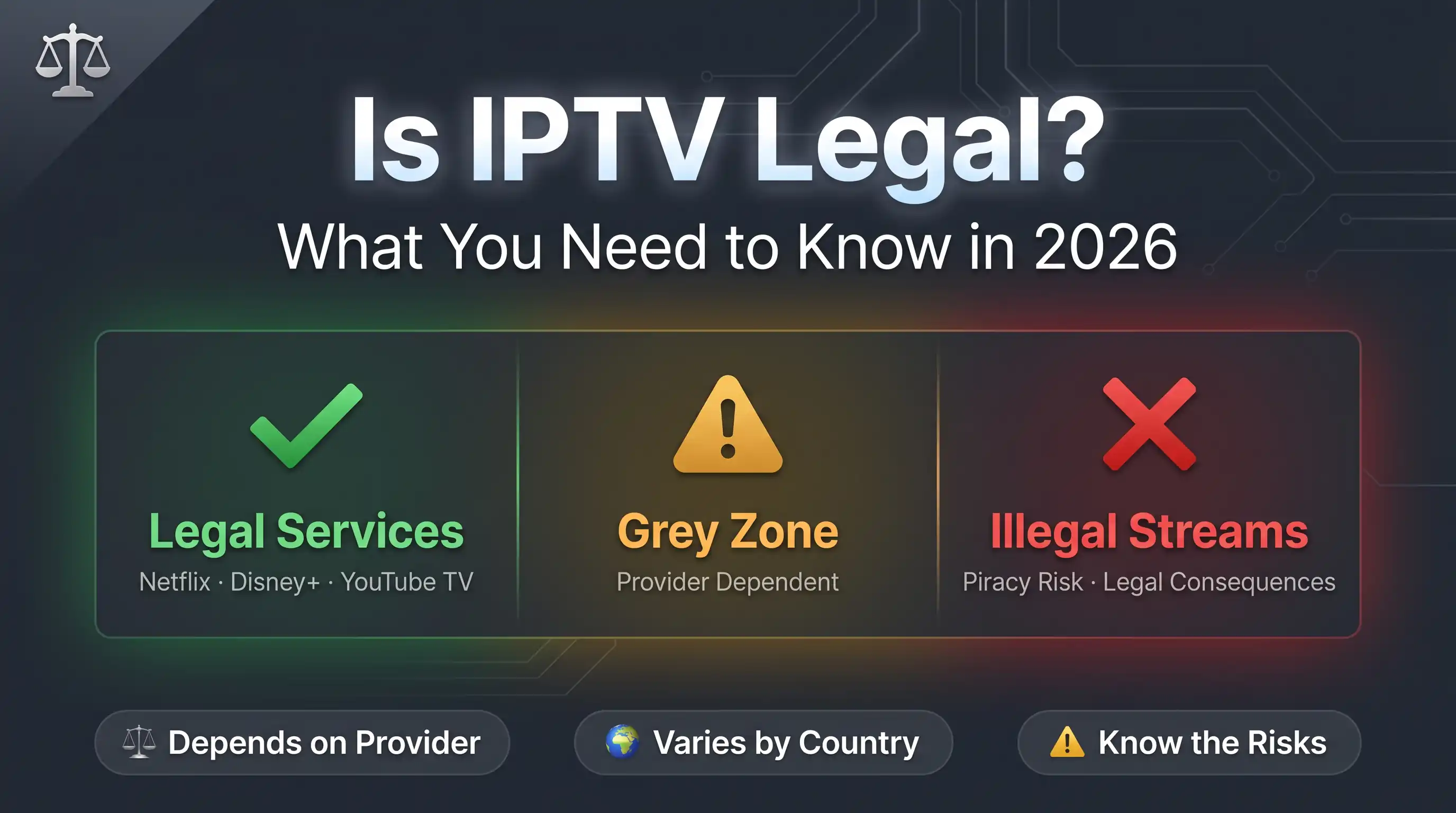
Short answer: the technology is legal. The service might not be.
IPTV stands for Internet Protocol Television. It is a way of sending video over the internet instead of through a cable or satellite signal. BBC iPlayer is IPTV. Netflix is technically IPTV. The mechanism itself is completely neutral, the same way a USB drive is not illegal just because some people use it to copy films they did not pay for.
What determines whether a service is legal is whether it holds licences for the content it streams. That is the only question that actually matters.
Two types of service, one outward appearance
There are licensed IPTV services and unlicensed ones. They can look almost identical from the outside. Both have channel lists, app icons, and customer support contacts. The difference is in the paperwork no one sees.
A licensed service has agreements with the broadcasters whose content it distributes, or holds a broadcasting licence that covers what it streams. It pays for what it shows. An unlicensed service does not. It pulls content from other sources without permission and sells access at whatever price it can get away with, usually very low, because its costs are near zero.
The price gap between the two is reliable as a signal. A service offering 50,000 channels for ten dollars a month has not paid for the rights to 50,000 channels. The maths does not work any other way.
What the risk looks like for subscribers
Legal exposure for subscribers varies by country. UK and EU enforcement has historically focused on the operators running the unlicensed services rather than the people subscribing to them. That said, several court rulings in the past few years have found that knowingly using unlicensed streams does constitute infringement on the viewer’s side.
There is also a more immediate practical risk. Unlicensed services disappear. The domain stops resolving, the WhatsApp number goes silent, and the streams stop working. Sometimes this happens after a few months, sometimes the week after you paid for a year. There is no recourse when it does.
How to check a service before you pay
Ask for a licence number. Legitimate services can give you one. In the UK, Ofcom publishes a public register of all current broadcast licensees, searchable by name. Most EU countries have an equivalent national regulator. If a service cannot point you to an entry in one of those registers, you have your answer.
Look at how long the service has been operating on the same domain. Two or more years at the same address, with a traceable company behind it, is not a guarantee but it is a meaningful filter. Services that rotate through variations of the same brand name on fresh domains are almost always unlicensed resellers.
Check whether there is a registered company behind it. Companies House in the UK, the relevant commercial register elsewhere. A real business has a registration number. It is a five-minute check.
Where Vivimate stands
We hold a broadcasting licence and publish the number on our licensing page. You can look it up against the regulator’s records directly. We are not asking anyone to take that on trust.
The check process above applies to us the same as it applies to any other service. If you are comparing options, run every candidate through the same questions. Licence number, domain age, registered company. The ones that come up blank on all three are telling you something.